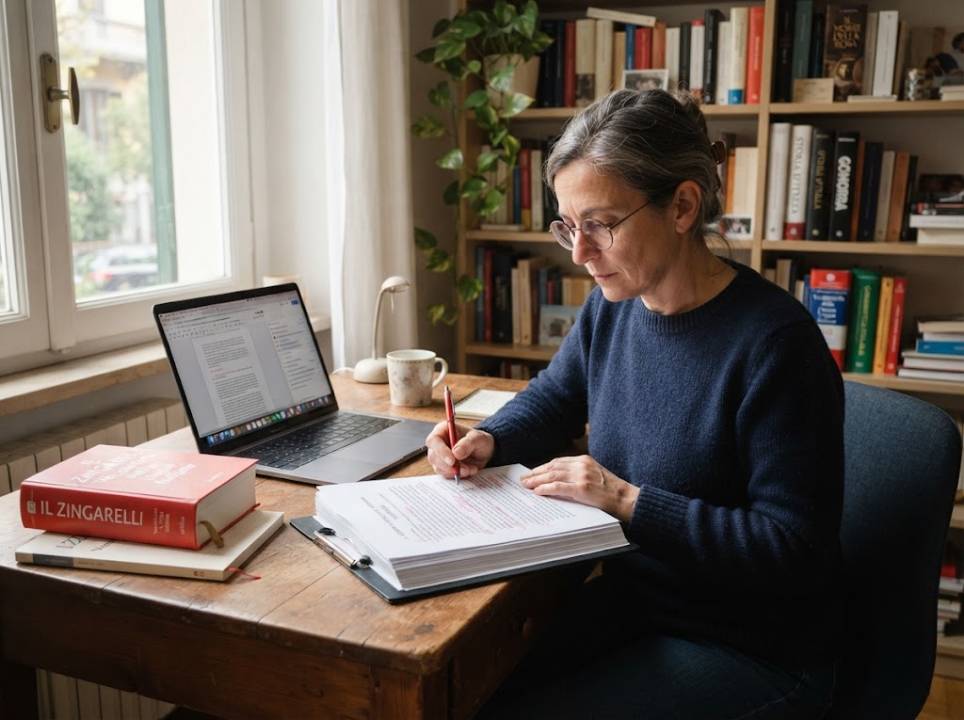
A translation can look polished and still hide small mistakes. Before you publish an Italian text, print a brochure or send a contract, a careful proofreading pass catches the errors that spell checkers miss. Here is a practical routine that any editor or business owner can follow.
Read the Italian text on its own
Start by reading the translation without the English original beside it. Does it sound natural, or does it feel stiff and foreign?
If a sentence makes you stop and reread, mark it. Readers will stumble in the same place.
Compare with the source
Next, place the original next to the translation and check each paragraph for omissions, additions and shifts in meaning. Numbers, names and dates deserve a second look.
Make sure that nothing was dropped, especially in lists, footnotes and captions.
Check grammar and agreement
Italian marks gender and number on articles, nouns and adjectives. A single mismatch, such as a feminine noun with a masculine adjective, stands out immediately to native readers.
Verb tenses also need attention, since English and Italian use them differently in reports and instructions.
Look at punctuation and spelling
Italian uses accents on final vowels, such as the difference between "e" and "è". These small marks change the meaning of a sentence.
Check apostrophes, quotation marks and capital letters, because rules differ from English, especially in titles and headings.
Watch for false friends
Words that look alike in English and Italian often differ in meaning. "Eventually" and "eventualmente" are a classic pair, and "actually" does not match "attualmente".
Keep a short list of false friends in your field and scan the text for each one.
Use a professional proofreader
An independent second reader catches what the first translator no longer sees. A provider of Italian translation can supply both translation and review as separate steps.
Ask for tracked changes, so you can see what was corrected and why.
Check terminology
Compare the translation against your glossary. Product names, job titles and technical terms should appear in the same form across the document.
If there is no glossary, create one now from the terms you find, and share it for future projects.
Academic and official papers
Certificates and transcripts need strict accuracy. A guide on diploma and transcript translation explains how grades, titles and institutions should be handled.
Never change a name or a grade to make it sound better. Fidelity matters more than style.
Test layout and formatting
Italian text is often longer than English, so headings and buttons may overflow. Check line breaks, tables and page numbers after the translation is placed in the final design.
Make sure that accented letters display correctly in every font used.
Follow a quality standard
Quality frameworks help set expectations. The ISO 17100 standard describes how translation and revision should be organised, including a second linguist who checks the work.
Ask your provider whether they follow a similar process.
Read aloud
Reading the text aloud is one of the oldest editing tricks. Your ear picks up awkward rhythm and repeated words that your eyes miss.
If possible, ask a native speaker to read it to you and mark where they hesitate.
Keep a change log
Record each correction with the reason. Over time you will see patterns, such as repeated agreement errors, that you can fix at the source.
A change log also helps new editors understand your preferences.
Plan enough time
Proofreading takes longer than people expect. A twenty page document may need a full day of careful review, plus time to apply corrections and check them again.
Schedule the review before the deadline, not on the day of publication.
Decide when it is done
No text is ever perfect, but there is a point where the remaining changes are only matters of taste. Agree on clear criteria, such as no factual errors, consistent terms and natural flow.
Once those are met, approve the text and archive the final version.
Review numbers and dates twice
Figures are the easiest items to get wrong and the hardest to spot. Italian uses a comma for decimals and a full stop for thousands, so 1.500 means one thousand five hundred, not one and a half.
Read every amount aloud and compare it with the original, line by line, before approving the text.
Check tone and register
Italian business writing is often more formal than English. A friendly email in English can sound too casual if translated word for word.
Decide whether your reader should be addressed as Lei or tu, and apply that choice to the whole document.
Share feedback with the translator
If you spot a recurring problem, tell your translator. Clear feedback improves the next project and often reduces review time by half.
Final advice
A clear routine turns proofreading from a vague worry into a simple checklist. Read, compare, check, test and approve, and your Italian text will be ready to represent you well.