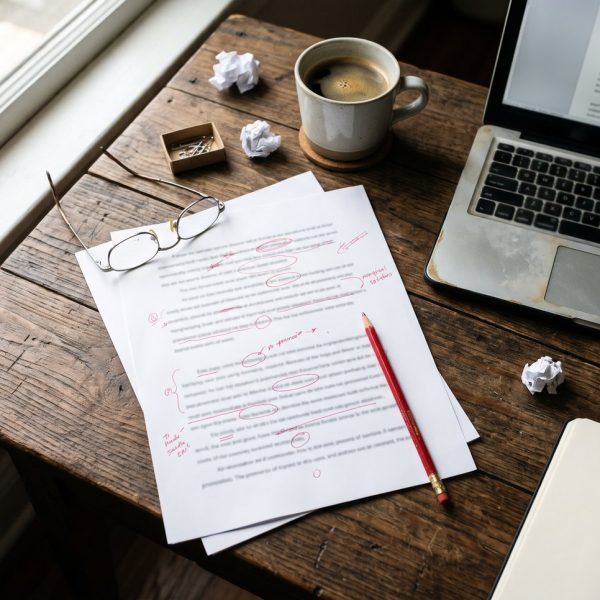
If you have ever handed a manuscript, a report or a website page to someone and asked them to "just tidy it up", you have already asked for copy editing, whether you knew it or not. So what is copy editing, exactly, and how is it different from the other kinds of review that writers hear about? This guide explains the work in plain terms, so you can decide what your text actually needs before you pay for it.
What is copy editing in practice?
Copy editing is a careful line-by-line pass that improves the clarity, consistency and correctness of a piece of writing without changing its voice or its message. A copy editor checks grammar, spelling, punctuation and syntax, but also looks at the things that readers feel without being able to name: a sentence that runs too long, a term that is spelled two different ways, a paragraph that repeats what the previous one said. The goal is that nobody notices the editing at all.
Most professionals describe it as the stage between developmental editing (where structure and argument are shaped) and proofreading (the final check for leftover slips). The overview of copy editing on Wikipedia summarises how the role developed in publishing and journalism, and why it remains a core part of any serious editorial workflow.
What a copy editor actually checks
The checklist is longer than most people expect. Alongside spelling and punctuation, a good copy editor looks at consistency of style: capitalisation, hyphenation, number formats, date formats and the way headings are written. If your document says "e-mail" on page two and "email" on page nine, the editor will choose one and apply it everywhere, usually recording the choice on a short style sheet so later documents match.
Copy editors also watch facts and internal logic. They do not replace a fact-checker, but they flag figures that do not add up, names that change spelling halfway through, or a timeline that contradicts itself. Finally, they tighten flow and readability, smoothing awkward phrasing and querying jargon your audience may not know. For business texts this often has the biggest effect, because a clearer paragraph is simply easier to act on.
Copy editing vs proofreading
The two jobs are often confused, and the confusion costs people money. Copy editing happens while the text can still change. Proofreading happens at the very end, on a layout that is ready to print or publish, and it looks only for errors that slipped through: a stray comma, a missing word, a broken line. If you hire a proofreader to do a copy editor's job, they will not rework heavy sentences. If you hire a copy editor to proofread a finished layout, you are paying more than you need to.
For a detailed side-by-side look at the two stages, this comparison of copy editing and proofreading walks through typical examples and when each one fits. If your text is already near its final form, it may also help to read what proofreading involves before you decide.
Who needs copy editing services?
Authors preparing a book are the classic customers, but they are far from the only ones. Researchers submitting a paper to an international journal rely on copy editing to meet the journal's house style. Companies use it for annual reports, white papers and product pages, where one clumsy sentence can weaken an otherwise strong argument. Non-native speakers writing in English often find it the most valuable investment of all, because a skilled editor keeps their ideas intact while removing the small signs that can make a text feel foreign.
How to prepare your text for a copy editor
A little preparation makes the edit faster, cheaper and better. Finish your own revisions first, because editing a draft that is still changing means paying twice for the same work. Tell the editor who the readers are, which spelling variety you use (British, American or another) and whether a style guide applies. Share any glossary of names and brand words so they are not "corrected" by mistake. Ask for tracked changes rather than a clean file, so you can accept the fixes you agree with and learn the patterns in your own writing.
How much does copy editing cost?
Pricing depends on length, condition of the text and subject difficulty. Editors typically charge per word, per page or per hour, and a clean, well-organised draft will always cost less than one that needs heavy rewriting. Ask for a short sample edit on a page or two of your text. It is the quickest way to judge whether a particular editor suits your voice, and professionals expect the request. Writers who like to compare notes on rates will find lively discussion in communities such as the r/editors community on Reddit, where working editors share how they price jobs.
Choosing the right level of help
Not every text needs every kind of attention. A personal blog post may only need a light polish. A grant application deserves a full copy edit followed by a separate proofread. When you are unsure, describe the document, the deadline and the audience to an editor and ask what they would recommend. A good professional will tell you honestly if a lighter service is enough.
In the end, copy editing is about respect for the reader. It removes the small obstacles that make people stop, frown and reread, so that your ideas arrive the way you meant them.