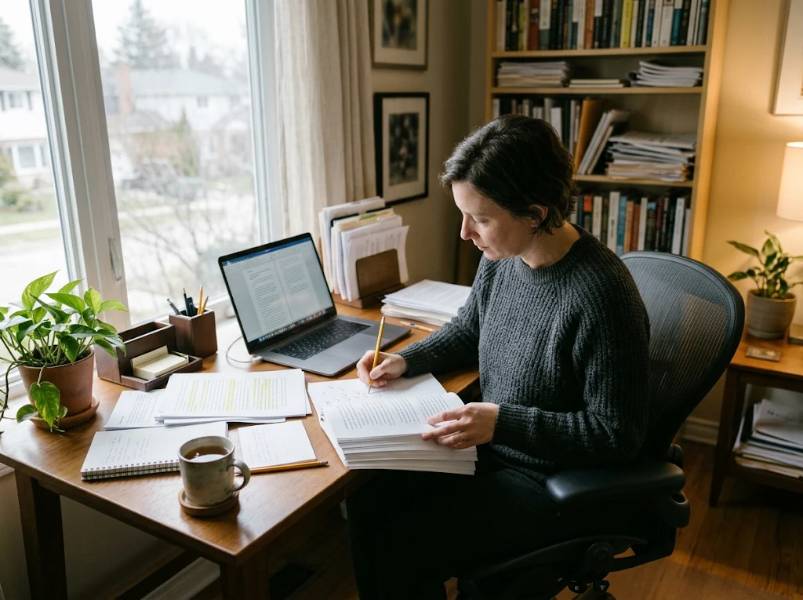
Good writing rarely appears in the first draft. Editing and proofreading turn rough text into clear, professional work that readers trust. These tips cover the main stages of improving a text, including special points for translated content.
Know the difference between editing and proofreading
Editing improves content, structure, clarity and style, while proofreading checks spelling, punctuation, grammar and formatting at the end. Mixing them in one pass leads to missed errors.
Edit first, proofread last, and never skip either step.
Let the draft rest
Reading immediately after writing makes it hard to see mistakes because the brain fills in what you meant. Take a break of several hours or a day when possible.
Fresh eyes find problems faster.
Check the structure
Make sure that the text has a clear beginning, logical sections and a useful ending. Each paragraph should have one main idea, and headings should help readers scan.
Move or delete sections that do not support your point.
Focus on the reader
Ask who will read the text, what they already know and what they need to do afterward. Adjust the level of detail and vocabulary to that person.
Clear purpose makes every editing decision easier.
Cut unnecessary words
Remove filler phrases, repeated ideas and long introductions. Short sentences with strong verbs are easier to understand.
Read your text aloud to hear where it drags.
Prefer active voice and concrete words
Active sentences show who does what. Specific nouns and numbers are more convincing than vague descriptions.
Keep passive voice for cases where the doer is unknown or unimportant.
Keep consistency
Names, terms, spelling variants, capitalization, dates and numbers should follow one style throughout. A style sheet that records decisions helps teams and freelancers.
Consistency makes writing look professional.
Check grammar and punctuation
Look for subject and verb agreement, tense errors, misplaced commas and apostrophes. Use a trusted guide for doubts.
The Purdue Online Writing Lab offers clear explanations of grammar, punctuation and style rules.
Use tools carefully
Spelling and grammar checkers catch many errors, but they miss context and can suggest wrong changes. Treat them as assistants, not final judges.
Always read the final version yourself.
Verify facts and numbers
Check names, dates, quotations, figures and links against the sources. Errors in facts damage trust faster than spelling mistakes.
Keep notes on where each key fact came from.
Edit translated text with care
A translation can be correct and still sound unnatural. A reviewer who reads the target text first can spot awkward phrases before comparing with the source.
Our guide to Polish to English translation shows common issues that editors should look for.
Consider Hungarian examples
Hungarian is an agglutinative language with long words, unusual word order and strong formal conventions. Editors who do not know these features may change correct text or miss errors.
Businesses often use Hungarian translation services with native reviewers who know both the language and the subject.
Check layout and formatting
Make sure headings, lists, tables, fonts and spacing are consistent. Check page breaks, captions and links in the final file.
Print or preview the document to see what readers will see.
Give and receive feedback
Be specific, kind and clear, and explain why a change helps. When receiving comments, look for patterns instead of defending each sentence.
Good feedback improves both the text and the writer.
Create a final checklist
List the items you always check, such as names, dates, numbers, headings, links and file name. Use it before every delivery.
A checklist prevents repeated mistakes.
Keep learning
Read widely, study style guides and review your own old work. Skill improves with attention and regular practice.
With steady habits, your editing and proofreading will make every text clearer and more professional.
Edit for different channels
A website, a report and an email need different lengths and tones. Adjust headings, paragraphs and calls to action for each medium.
Check how text looks on a phone screen.
Protect your own voice
Editing should improve clarity without removing personality. Keep expressions that are natural for the author and fit the audience.
Good editors preserve style while fixing problems.
Plan time for editing
Include editing and proofreading in project schedules and budgets. Rushing the final stage is the most common reason for errors in published work.
Allow at least a day for review of important documents.
Work with professional editors
A fresh, trained reader can see unclear passages and inconsistencies that the author cannot. Share the purpose, audience and style guide with them.
Professional review is an investment in credibility.
Build a style sheet
Record decisions about spelling, hyphenation, capitalization, numbers and preferred terms in one short document. Share it with every writer and editor.
A style sheet ends repeated debates and speeds up review.
Proofread in different ways
Read the text backward, line by line, to catch spelling slips. Then read it aloud, and finally check the layout on screen or on paper.
Different methods reveal different kinds of errors.
Ask a second reader
Someone who has not seen the text before will notice gaps in logic and unclear references. Ask them to summarize the main point after reading.
If the summary is wrong, the text needs another edit.